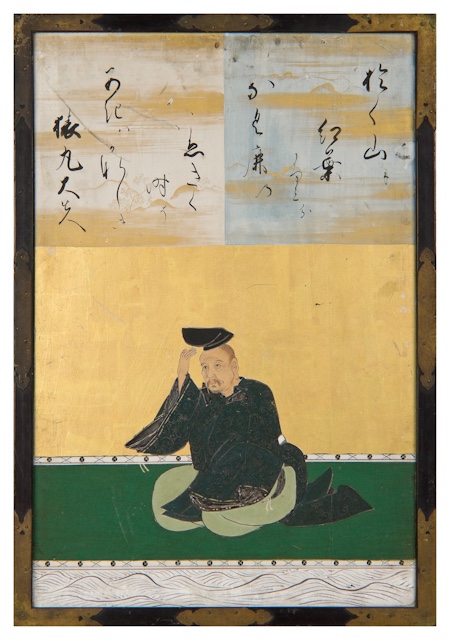
Welcome, dear reader, to Day 5 of our journey through the captivating world of classical Japanese poetry. Today, we delve into the life and verses of Sarumaru no Taifu, also known as Sarumaru no Dayū (猿丸大夫), a waka poet from the early Heian period. Here we delve into the mysteries surrounding this enigmatic poet and explore the his poetic contribution to the great 100 Poems of Classical Japan, the Hyakunin Isshu.
Sarumaru no Taifu holds a distinguished place among the Thirty-Six Poetic Sages (三十六歌仙, Sanjūrokkasen), yet intriguingly, there are no detailed histories or legends about him. Some even question whether he truly existed as a historical figure or was perhaps an embodiment of poetic expression itself. It is this sense of mystique that draws us deeper into the allure of his words.
As we embark on this journey, let us immerse ourselves in the exquisite verses of Sarumaru no Taifu, each carefully chosen to convey the essence of his poetic vision. Through my translations, I strive to capture the delicate nuances, the vivid imagery, and the emotional depth that resonates across the centuries.
But our exploration does not stop here. If you have not yet had the chance, I invite you to visit my website, NicholasAndriani.com, where you can read my interpretations of the Hyakunin Isshu poems from Day 1, Day 2, Day 3, and Day 4. Together, we unravel the tapestry of Japanese literary heritage, infusing it with a contemporary vibrancy that speaks to our modern hearts.
So, let us embark on this poetic adventure, where ancient and modern intertwine, where the echoes of Sarumaru no Taifu’s verses awaken our senses and ignite our imaginations. Join me as we discover the profound significance of classical Japanese poetry and its timeless relevance in our lives.
Sarumary no Dayū (猿丸大夫)
Sarumaru no Taifu, also known as Sarumaru no Dayū (猿丸大夫), was an enigmatic waka poet who flourished during the early Heian period. While he is recognized as a member of the esteemed Thirty Six Poetic Sages, the details of his life remain shrouded in mystery. In fact, there are no concrete historical accounts or legends that shed light on his existence, leaving room for speculation and intrigue. Some intriguing theories suggest that Sarumaru may have been none other than Prince Yamashiro no Ōe, adding an extra layer of fascination to his enigmatic persona.
Now, let’s delve into one of Sarumaru’s poignant poems and bring its essence to life for modern readers:
猿丸大夫
奥山に
紅葉ふみわけ
鳴く鹿の
声きく時ぞ
秋は悲しき
奥山に (Okuyama ni) – In the depths of the mountains,
紅葉ふみわけ (Momiji fumiwake) – Treading through crimson autumn leaves,
鳴く鹿の (Naku shika no) – The cries of a deer,
声きく時ぞ (Koe kiku toki zo) – Heard at this moment,
秋は悲しき (Aki wa kanashiki) – Autumn is melancholy.
This evocative verse captures the bittersweet beauty of the season, where nature’s vibrant hues intermingle with a sense of longing and melancholy. As we explore Sarumaru’s poetic world, we invite you to immerse yourself in the rich tapestry of emotions and imagery woven within his verses.
Localization and Line-by-Line Translation
Let’s break down the translation of this poem line by line and explore the philosophy behind my approach to translating and localizing it:
In the depths of the mountains (奥山に, Okuyama ni), I want to convey a sense of seclusion and tranquility, transporting readers to a serene natural setting. It sets the stage for the imagery that follows.
Treading through crimson autumn leaves (紅葉ふみわけ, Momiji fumiwake), I aim to paint a vivid picture of walking amidst vibrant foliage, immersing readers in the beauty of nature. It evokes a sense of intimacy and connection with the surroundings.
The cries of a deer (鳴く鹿の, Naku shika no), symbolize the core imagery of the poem. By preserving the metaphorical power of the original, I want readers to feel the deep emotions and yearning associated with the deer’s cry, creating a sense of resonance.
Heard at this moment (声きく時ぞ, Koe kiku toki zo), I emphasize the fleeting nature of the experience. It captures the essence of a specific moment, inviting readers to reflect on the transient beauty of life and nature.
Autumn is melancholy (秋は悲しき, Aki wa kanashiki). This line encapsulates the overarching sentiment of sadness and nostalgia that autumn carries. I want readers to feel the bittersweet emotions tied to the season, fostering a connection between their own experiences and the poem.
In translating this poem, I strive to not only convey the literal meaning but also capture the essence and emotional depth that the original text holds. I believe in preserving the vivid imagery, the delicate balance between nature and emotions, and the subtle musicality of the language.
My approach aims to bridge different eras and cultures, allowing readers to appreciate the beauty of classical Japanese poetry in a contemporary context. By blending my translation skills with a deep appreciation for the cultural nuances, I hope to create a connection between readers and the timeless verses.
If you want to explore more translations, I invite you to visit my website NicholasAndriani.com, where you can find my interpretations of other Hyakunin Isshu poems from Day 1, Day 2, Day 3, and Day 4. Let’s embark on this poetic journey together, discovering the profound beauty and cultural richness of Japanese literature in a fresh and captivating way.
Catching up
To catch up on previous translations and embark on a poetic journey through time, visit NicholasAndriani.com for Days 1, 2, 3, and 4. Stay tuned as we continue to unravel the enigmatic realms of ancient Japanese poetry, one day at a time.
- Considering Cultural Heritage: Takachiho, Miyazaki, Japan, Shinto, and the Ritual Yokagura (夜神楽)
- AMP_SurvivalWild_FullAssetGuide_v3
- AMP_SurvivalWild_FullAssetGuide_v1
- Confession: On Scattered Altars and the Art of Finishing Things and New Poetry
- Protected: Introducing “Lu and Monie Glow Up” – Writing a New Animated Series About Found Families, Neurodivergence, and Living Artfully
Bonus Segment: Let’s party like it’s 1889 – Nintendo edition

Hanafuda (花札) are a playing card game, no not like Pokémon, think Guess Who? meets Crazy Eights… with a splash of Mahjong… not to disparage the uniqueness or complexity of hanafuda.
The history of playing cards in Japan is a fascinating tale that intertwines cultural exchange and government prohibition. The Portuguese introduced playing cards to Japan in the mid-16th century, and these decks consisted of 48 cards with four suits divided into 12 ranks. The first Japanese-made decks, known as Tenshō Karuta, were created during the Tenshō period (1573–1592) and closely resembled the Portuguese decks.
However, with Japan’s decision to isolate itself from the Western world in 1633, foreign playing cards were banned. In 1648, the Tokugawa shogunate further enforced this prohibition by banning Tenshō Karuta. Despite the ban, gambling with cards remained highly popular, leading to the emergence of disguised card designs. Each time a particular card deck design gained popularity, the government would ban it, prompting the creation of new designs.
This cat-and-mouse game between the government and rebellious gamblers gave rise to increasingly abstract and minimalist regional patterns known as “地方札” (chihō-fuda). Initially called Yomi Karuta, named after the popular Poch-like game of Yomi in the 1680s, these designs evolved as the government crackdown intensified.
During the Meiwa, An’ei, and Tenmei eras (roughly 1764–1789), a game called Mekuri replaced Yomi as the dominant card game. Mekuri Karuta, as it came to be known, gained immense popularity. Mechanically similar to Chinese fishing games, Mekuri offered a new twist to card enthusiasts. However, the government banned cards for gambling purposes in 1791 during the Kansei era.
Interestingly, the earliest known reference to Hana Awase, a precursor to hanafuda, dates back to 1816, when it was recorded as a banned gambling tool. Unlike earlier decks, Hana Awase consisted of 12 months (suits) divided into four rank-like categories. Many hanafuda games trace their roots back to Mekuri, although adaptations of Yomi using flower cards persisted until the 20th century. While hanafuda cards can still be used for gambling, their structure and design are less convenient compared to other decks like Kabufuda.
It wasn’t until the Meiji period that playing cards started gaining tolerance from the authorities, marking a shift in their acceptance and cultural significance… and then in 1889 a little company you may have heard of erupted the scene. Nintendo.

A workshop in Shimogyō-ku, Kyoto, c. 1889
Enter Nintendo or, “Leave Luck to Heaven?”
In 1889, a humble Japanese playing card company named Nintendo was founded by Fusajiro Yamauchi. Little did he know that this small venture would lay the foundation for one of the most influential and beloved entertainment companies in the world.
The Kanji can translate to “leave luck to heaven.” But as to the actual, intended meaning of Nin-ten-do, Yamauchi remained silent and dismissed all conjecture.
At the time of its establishment, Nintendo primarily focused on producing handcrafted playing cards known as hanafuda. These unique cards were not like the conventional Western-style playing cards we are familiar with. Instead, they featured exquisite designs inspired by the natural beauty of Japan, incorporating flowers, animals, and seasonal motifs.
Hanafuda cards quickly gained popularity among the Japanese population, especially among gamblers and enthusiasts seeking a touch of artistry in their card games. The intricate illustrations and the strategic gameplay made hanafuda an engaging and captivating pastime.
As Nintendo continued to refine and expand its range of hanafuda cards, they became a symbol of Japanese craftsmanship and cultural heritage. The company’s dedication to quality and attention to detail soon earned them a reputation for producing some of the finest playing cards in the country.
Nintendo’s success with hanafuda cards laid the groundwork for their future endeavors in the world of entertainment. While the company would eventually explore various ventures, from toy manufacturing to electronic games, the spirit of creativity and innovation embedded in their early playing card business would remain a core part of their identity.
Today, Nintendo is widely recognized as a global leader in the gaming industry, known for iconic franchises like Super Mario, The Legend of Zelda, and Pokémon. However, it is essential to recognize and appreciate the company’s humble beginnings with hanafuda cards, as it showcases their deep-rooted connection to traditional Japanese culture.
As we marvel at the technological wonders of Nintendo’s modern gaming consoles and immersive experiences, let us not forget the artistry and history embodied in those simple yet captivating hanafuda cards. They serve as a reminder of Nintendo’s rich heritage and the enduring cultural significance of traditional games.
If you’re intrigued by the fascinating journey of Nintendo and its diverse range of gaming experiences, I invite you to explore more on my website at NicholasAndriani.com. Join me in celebrating the legacy of hanafuda and the remarkable evolution of Nintendo, as we continue to embrace the joy and wonder of gaming in all its forms.
Hanafuda: Resources and How-To
- Nintendo eventually released a modernized format featuring beloved characters from various IPs such as Mario and Kirby. A players guide and instructions can be found here
- Ancient Gaming, one of YouTube’s finest, documents the history of games and play. Check out their feature on hanafuda here.
- Purchase your own set of Nintendo hanafuda here below!
- Purchase your own Nintendo Hanafuda Playing cards here!

Leave a Reply