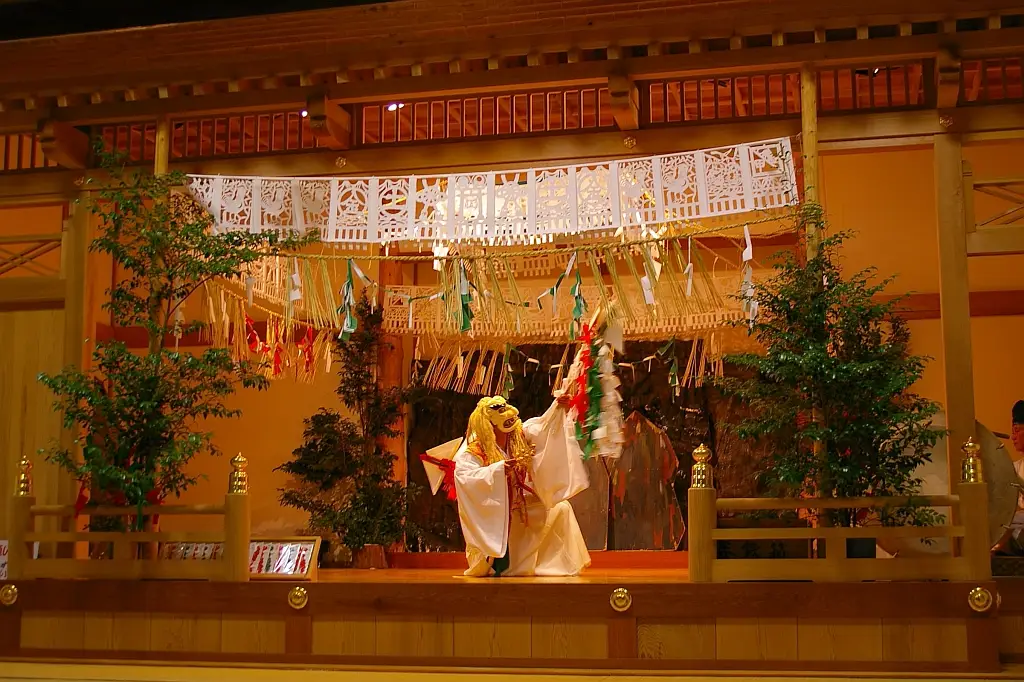
There’s a town of 11,000 people in the mountains of southern Japan where, every winter, farmers become gods.

日本語: 高千穂の夜神楽
Between November and February, across roughly twenty villages in the Takachiho district of Miyazaki Prefecture, communities perform yokagura — all-night Shinto ritual dances that cycle through 33 episodes from Japan’s foundational mythology. From dusk to dawn, ordinary people — rice farmers, shopkeepers, municipal workers — wear carved wooden masks weighing up to 20 kilograms and reenact the moment the sun goddess Amaterasu hid in a cave and plunged the world into darkness, and the ecstatic dance of Ame-no-Uzume that lured her back out.
Before you go chocking this to spectacle, I assure you it is not a festival packaged for tourist consumption but a living relational practice — an offering to the kami who sustain the land, timed to the agricultural calendar because it is, at its root, a thanksgiving for the harvest and a petition for next year’s abundance. The communal feast that accompanies the dances — shoke-mori, served in bamboo baskets — is itself a ritual act.
I had the immense privilege of joining the Yokagura this year and participating in the liminal boundary between the human community and the sacred community.
We danced. We feasted. And for a time being our world deliberately dissolved unto that of the gods.
I’ve been researching yo-kagura as part of my graduate work in Japanese and comparative narrative theory, and I recently completed an cursory essay promoting Takachiho’s cultural identity as constituted by four interlocking heritages that cannot function independently: the Takachiho Gorge (a volcanic canyon that doubles as the physical setting for Japan’s creation mythology), the yo-kagura tradition, the FAO-designated Globally Important Agricultural Heritage System (GIAHS) that recognizes the region’s centuries-old mountain farming as heritage that transcends economic mandates, and the network of Shinto shrines — anchored by Takachiho Shrine and Amano Iwato Shrine — that provides the institutional and spatial infrastructure holding everything together.
The argument is simple but, I think, important: remove any one of these heritages and the others lose their coherence. Yo-kagura happens because of the harvest. The harvest is structured by the agricultural system. The agricultural system is understood through Shinto cosmology. The cosmology is anchored in the gorge and the shrines.
Trust me when I say these are not four isolated heritage assets but one integrated cultural ecosystem.
What struck me most in the experience — and what connects Takachiho to my own Romani-Transylvanian heritage — is the recognition that the most resilient heritage systems are not the ones with the best archives or the most prestigious designations. They are the ones where people give breathe into praxis, where verbs transcend nouns, perform and claim what only embodied knowledge provides. Takachiho’s yo-kagura survives not because someone digitized it (though documentation exists) but because the village communities still experience the ritual as spiritually, agriculturally, socially necessary. The archive is the community. The database is the body that dances.
Dance, dance, dance!
For those of us working in heritage preservation, information science, or public pedagogy, Takachiho offers a provocation: What if the most important preservation work isn’t about recording knowledge but about sustaining the conditions under which knowledge continues to be practiced?
I’ll be sharing more from this research in coming weeks, including connections to Indigenous knowledge sovereignty, the politics of heritage tourism in depopulating rural communities, and what Shinto ritual performance can teach narrative theorists about embodied storytelling.
Recommended Reading
My Essay: Where the Gods Descended:
Four Cultural Heritages That Define Takachiho, Miyazaki Prefecture
Takachiho Gorge & Landscape:
- Takachiho Gorge (main image): https://commons.wikimedia.org/wiki/File:Takachiho-gorge.jpg
- Manai Falls: https://commons.wikimedia.org/wiki/File:Manai_Falls_Takachiho.jpg (check user page STA3816 for additional high-res Takachiho images)
- Amano Yasukawara cave shrine (stone cairns): https://commons.wikimedia.org/wiki/File:天安河原_-_panoramio.jpg
Yo-Kagura / Kagura Performance:
- Yokagura Sacred Dance: https://commons.wikimedia.org/wiki/File:Yokagura_Sacred_Dance_(31561847845).jpg
- Yokagura (general): https://commons.wikimedia.org/wiki/File:Yokagura.jpg
- Uzume dance figure: https://commons.wikimedia.org/wiki/File:Uzume.jpg
- Kagura suzu bells (performance video): https://commons.wikimedia.org/wiki/Category:Kagura_suzu
Kagura-den (Dance Halls at Shrines):
- Browse the full category for shrine dance hall images: https://commons.wikimedia.org/wiki/Category:Kagura-den
Full Takachiho Category (browse all):
General Kagura Category:
- https://commons.wikimedia.org/wiki/Category:Kagura
- Takachiho Kagura dance performance | See & Do | Visit MIYAZAKI -Official Tourism Website of Miyazaki Prefecture-


.jpg)


Leave a Reply