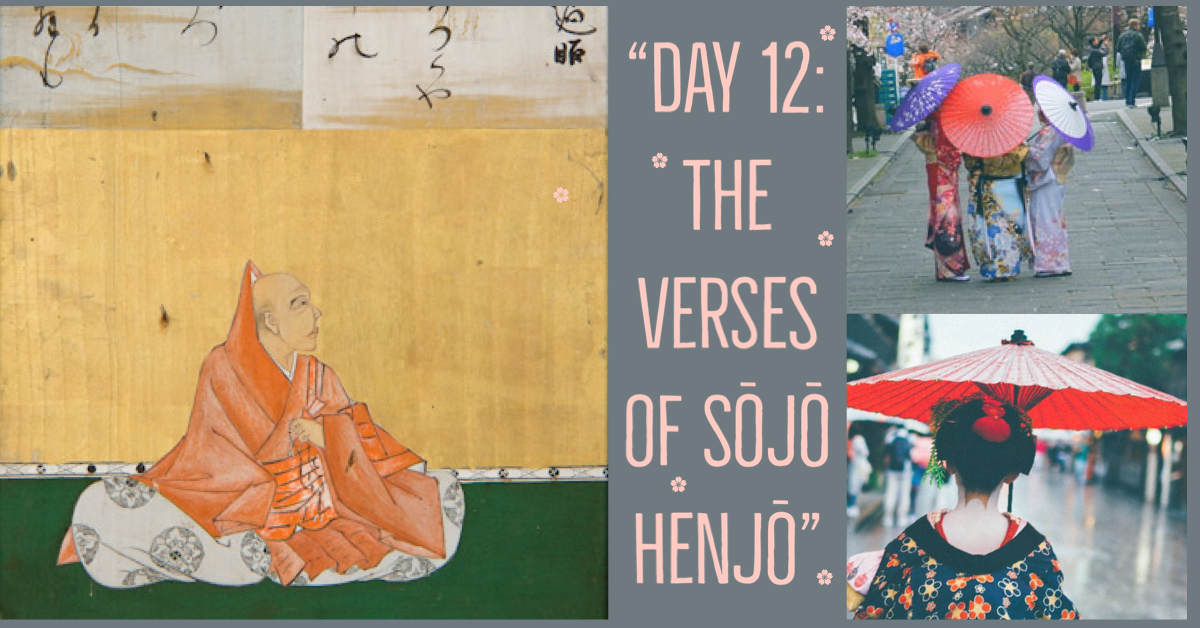
Welcome to Day 12 of our poetic journey through the Hyakunin Isshu. Today, we delve into the fascinating world of the poet Sōjō Henjō (僧正遍昭). Renowned for his contributions to Japanese literature during the early Heian period, Henjō’s poetry showcases his deep connection to nature and the human experience.
In this beautiful poem, Henjō paints a vivid picture of a fleeting moment in time. As the wind carries the clouds across the sky, he muses on the path they traverse. The poet then envisions the form of a young maiden, capturing her image as if he could hold it forever.
Join me as we explore the ethereal beauty and philosophical reflections encapsulated in Sōjō Henjō’s verses. Through the lens of translation and localization, we aim to capture the essence of his poetic vision while inviting contemporary readers to embark on this literary adventure. So, let us immerse ourselves in the language and wisdom of the past, uncovering the treasures that lie within the Hyakunin Isshu.
天つ風
雲のかよひ路
吹きとぢよ
乙女のすがた
しばしとどめむ
The heavenly breeze
Blows along the path of clouds,
Gently swirling.
The figure of a young maiden,
I wish to capture in my heart for a while.
Localization and Word Choice:
In this translation, we aim to retain the poetic beauty and essence of the original Japanese while making it accessible and relatable to American audiences. The first two lines talk about the wind and clouds, a classic motif in Japanese poetry symbolizing transience and impermanence. To maintain the imagery and evoke a similar feeling, we use “heavenly breeze” to convey the sense of a gentle, ethereal wind. “Path of clouds” reminds readers of the ever-changing nature of clouds’ movement.
In the third line, “吹きとぢよ” is an archaic expression meaning “blowing gently” or “swirling softly.” To preserve the poetic elegance, we choose “gently swirling” as a modern equivalent.
In the final two lines, “乙女” refers to a young girl or maiden. To evoke a sense of youthful innocence, we use “young maiden.” “しばし” indicates a brief period of time. To convey the sentiment of cherishing a fleeting moment, we say “I wish to capture in my heart for a while.” The phrase “capture in my heart” resonates with English-speaking readers and enhances the emotional depth of the poem.
Overall, the localization process seeks to maintain the symbolic and emotional elements of the poem while ensuring it is relatable and evocative for American audiences, allowing them to experience the same sense of wonder and appreciation that the poet intended.
Starting here? Catch up on days 1-11
Embark on a poetic journey like no other! Start from day one and immerse yourself in the timeless beauty of Japanese literature. From the exquisite verses of Ono no Komachi to the contemplative musings of Sarumaru no Taifu, each day offers a new adventure into the soul-stirring world of classical Japanese poetry. Follow my translations as we explore the cultural nuances and poetic genius of these ancient masterpieces, bridging the gap between centuries and cultures. Don’t miss a single day of this enchanting challenge and join me in unlocking the wonders of the Hyakunin Isshu. Your literary odyssey awaits! 📚🌸

Leave a Reply