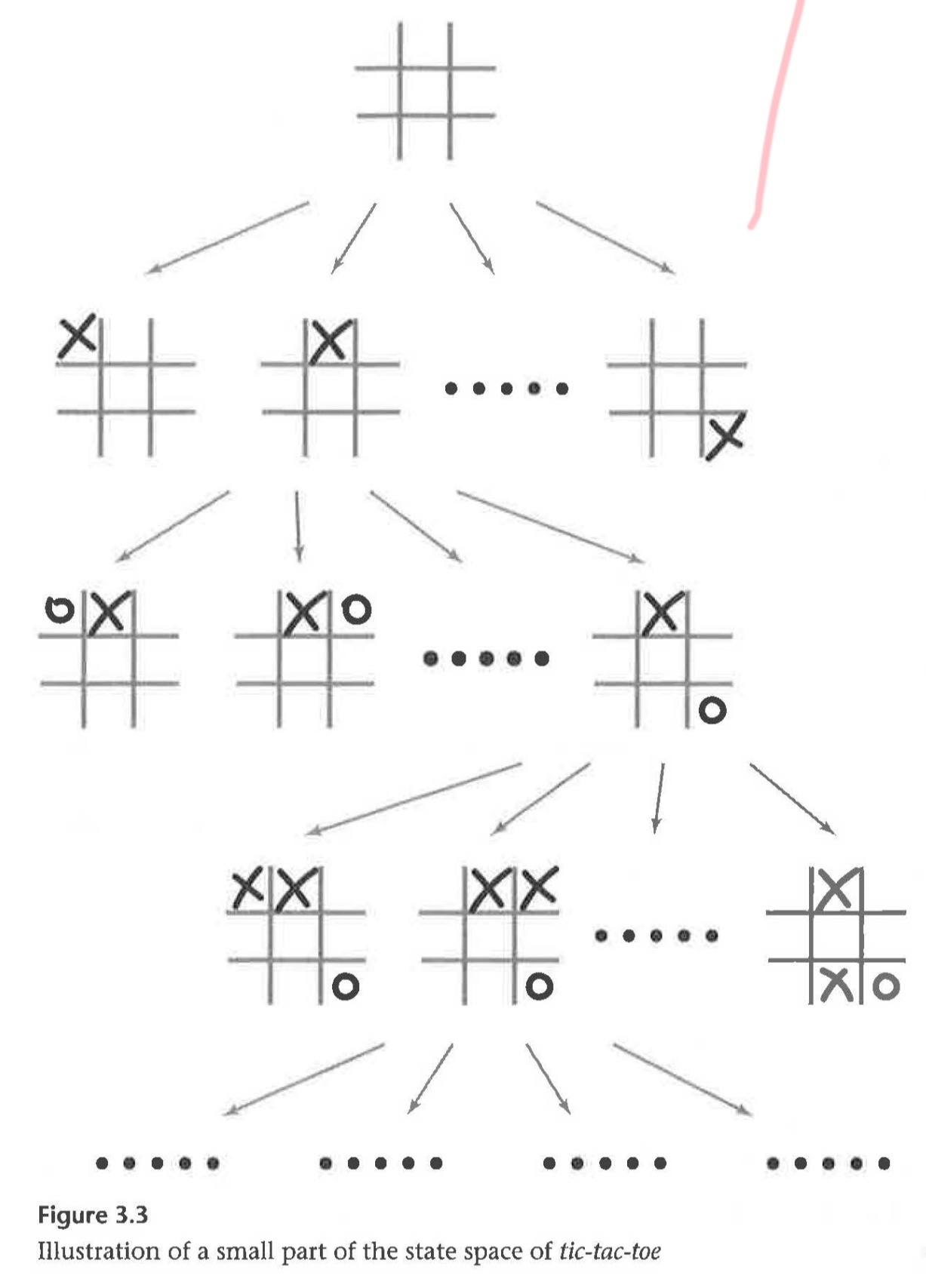
This morning, we’re exploring two significant concepts: the importance of good naming conventions in various creative domains, from scriptwriting to coding, and the astonishing multitude of possibilities within a simple tic-tac-toe game—precisely 362,880 possibilities! Imagine the potential for branching narratives here. In fact, this sparks an idea – what if we could craft a game that involves constructing poems using the framework of tic-tac-toe?
Zubek’s insights on mechanics in interactive entertainment, whether it’s in the realm of choose-your-own-adventure books, video games, or virtual reality experiences, are intriguing. The key takeaway is that we are crafting narratives that naturally branch into a series of possibilities for the audience to explore alternative modes of existence. This enables them to express themselves, engage in exercises, and experiment with self-directed agency in a specific format.
Quotes Zubek:
Size calculation for the simple game of tic-tac-toe seems
Zubek, Elements of Game Design. Pg. 49
straightforward: nine choices for player one, each of them followed by eight choices for player two, each followed by seven choices for player one, etc., for a total of 362,880 possible permutations (although that includes invalid or redundant states, so the actual useful subset of the space will be much smaller

Embracing the potential of narrative branching is not just a concept confined to the realm of gaming. It extends to storytelling in various forms, including interactive fiction, digital narratives, and even academic research. By recognizing that narratives can naturally permutate into numerous possibilities, we unlock a realm of creative expression and engagement.
In the world of interactive fiction, the audience becomes an active participant in the storytelling process. Much like a player in a game of tic-tac-toe makes a move that impacts the outcome, readers of interactive fiction make choices that steer the narrative’s direction. These choices, often referred to as branching points, create a web of diverse narratives within a single story.
Consider the choose-your-own-adventure books that many of us enjoyed as children. Each decision led to a different page, offering a unique story path. Similarly, in the realm of video games and virtual reality experiences, the choices players make shape the storyline, leading to various endings and outcomes.
The beauty of interactive storytelling is its ability to offer alternative modes of being, allowing the audience to explore various personas, perspectives, and outcomes. It’s a journey of self-expression and creativity, where readers or players can experiment with their agency in a controlled yet open narrative environment.

Now, let’s circle back to the idea of good naming conventions. In this context, the names we give to characters, places, and choices in interactive fiction are vital. A well-chosen name can provide insight into a character’s personality or foreshadow the consequences of a decision. Just as in coding, where meaningful variable and function names are essential for clarity and maintainability, in interactive storytelling, names guide the reader’s experience and understanding of the narrative.
In academic research, the importance of naming conventions cannot be understated. Researchers must employ precise terminology and nomenclature to ensure that their work is comprehensible and reproducible by others in the field. Clear and consistent naming conventions facilitate effective communication and understanding in scholarly endeavors.
In conclusion, the art of crafting branching narratives and good naming conventions is a harmonious blend of creativity and structure. Just as in a game of tic-tac-toe, where the choices of the players lead to diverse outcomes, our choices in narrative design and research naming conventions pave the way for an array of possibilities. Whether you’re exploring the world of interactive storytelling, coding, or academic research, remember that how you name and structure your work can significantly impact its reception and effectiveness.
References:
In academic research, the importance of naming conventions cannot be overstated. Properly named variables, concepts, and methodologies enable other researchers to understand and build upon your work. It ensures clarity, precision, and reproducibility in scientific endeavors.
References:
1. Ernst, D. (2002). Tic-Tac-Toe Theory. Retrieved from https://www.cs.swarthmore.edu/~adanner/cs21/s13/short-projects/dernst/
2. Murray, J. H. (1997). Hamlet on the Holodeck: The Future of Narrative in Cyberspace. MIT Press.
Further Reading:
- Montfort, N. (2005). Twisty Little Passages: An Approach to Interactive Fiction. The MIT Press.
- Nelson, M. (2013). How to Write Interactive Fiction and Narrative Design. CreateSpace Independent Publishing Platform.
- Spolsky, J. (2005). Making Wrong Code Look Wrong. Retrieved from https://www.joelonsoftware.com/2005/05/11/making-wrong-code-look-wrong/

Leave a Reply