
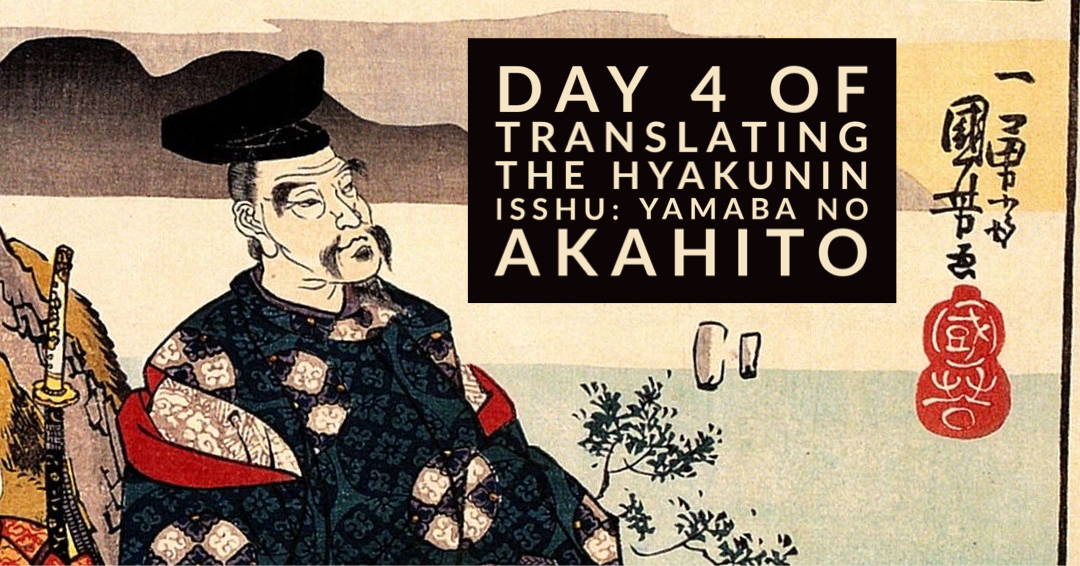
Hello folks. I hope you’re enjoying our journey thus far. As I’ve yet to receive any feedback I can only assume you’re madly in love with the project. 🙈😁
Ok. So where were we. Right, so we just left off from Day 3 which examined the work of Kakinomoto no Hitomaro (柿本人麻呂). Today we’re moving onto Yamabe no Akahito.
Yamabe no Akahito (山部 赤人 or 山邊 赤人) (fl. 724–736) was a poet of the Nara periodin Japan. The Man’yōshū, an ancient anthology, contains 13 chōka (“long poems”) and 37 tanka (“short poems”) of his. Many of his poems were composed during journeys with Emperor Shōmu between 724 and 736. Yamabe is regarded as one of the kami of poetry, and is called Waka Nisei along with Kakinomoto no Hitomaro. He is noted as one of the Thirty-six Poetry Immortals.
Yamabe no Akahito: A Journey Through Nara Period Poetry
Yamabe no Akahito, a distinguished poet of the Nara period in Japan, invites us on a poetic voyage through time. Renowned for his eloquence, Akahito’s verses can be found within the treasured pages of the Man’yōshū, an ancient anthology. With 13 chōka (long poems) and 37 tanka (short poems) to his name, he captures the essence of emotions and experiences through his lyrical artistry.
Many of Akahito’s compositions were inspired by his journeys alongside Emperor Shōmu between 724 and 736. These excursions provided him with rich opportunities to witness the beauty of nature, the passing seasons, and the subtleties of human existence. Through his words, he weaves a tapestry of vivid imagery, evoking a deep sense of connection between the external world and the inner realms of human emotion.
Akahito holds a revered position as one of the kami of poetry, bestowing him with the title of Waka Nisei, a distinction he shares with the esteemed Kakinomoto no Hitomaro. Their works resonate with the collective soul of Japan, transcending time and cultural boundaries.
As we embark on this literary adventure, let us delve into the poetic legacy of Yamabe no Akahito. Join us in uncovering the hidden gems within his verses, celebrating his contributions as one of the Thirty-six Poetry Immortals.
Subscribe to our translation journey to receive daily updates and discover the profound beauty of Classical Japanese Poetry. Catch up on Day 1, 2, and 3 to immerse yourself fully in the captivating world of the Hyakunin Isshu.
Let’s embark on this Nara-centered, Japanese poetic odyssey together!
Day 4: Yamabe no Akahito
田子の浦に
打ち出でてみれば
白妙の富士の高嶺に
雪はふりつつ山辺赤人
As I ventured forth to the shore of Tagono-ura,
I beheld a mesmerizing sight before me:
The pure white robes
Adorning the lofty peak of Mount Fuji,
While snowflakes gently descended.Yamabe no Akahito
Translation and Localization
Let’s dive into the essence of each line and the choices made in translating this captivating poem:
“田子の浦に” (Tagono-ura ni) – The shore of Tagono-ura: This evokes a sense of place and sets the scene for the unfolding imagery.
“打ち出でてみれば” (Uchidete mireba) – As I ventured forth: This phrase captures the speaker’s perspective, adding a touch of personal experience to the narrative.
“白妙の” (Shirotae no) – The pure white robes: I chose “robes” to convey the image of the snow-capped peak, symbolizing the beauty and serenity of Mount Fuji.
“富士の高嶺に” (Fuji no takane ni) – Adorning the lofty peak of Mount Fuji: This line emphasizes the majestic nature of Mount Fuji, emphasizing its grandeur and elevation.
“雪はふりつつ” (Yuki wa furitsutsu) – While snowflakes gently descended: By using “gently descended,” I aimed to capture the tranquil and serene quality of the falling snowflakes.
Now, let’s talk about the project of the 100 days of translation and your aspirations for a book deal:
Embarking on this 100-day translation challenge has been a profound journey, allowing me to delve into the captivating world of Classical Japanese poetry and share its timeless beauty with modern readers. Each day, I immerse myself in the delicate art of translation, carefully selecting words and phrases to preserve the essence of the original while ensuring accessibility for contemporary audiences.
Through this project, my aim is not only to connect with poetry enthusiasts and language lovers but also to showcase my expertise as a translator and cultural consultant. I aspire for this collection of translated poems to serve as a stepping stone toward a book deal, where these ancient verses can find a permanent place on the bookshelves of those who appreciate the rich tapestry of Japanese literature.
Join me on this enchanting journey, as we unravel the hidden gems of Classical Japanese poetry, one day at a time. Together, let’s celebrate the beauty of language, cultural exchange, and the timeless power of poetic expression.

Leave a Reply