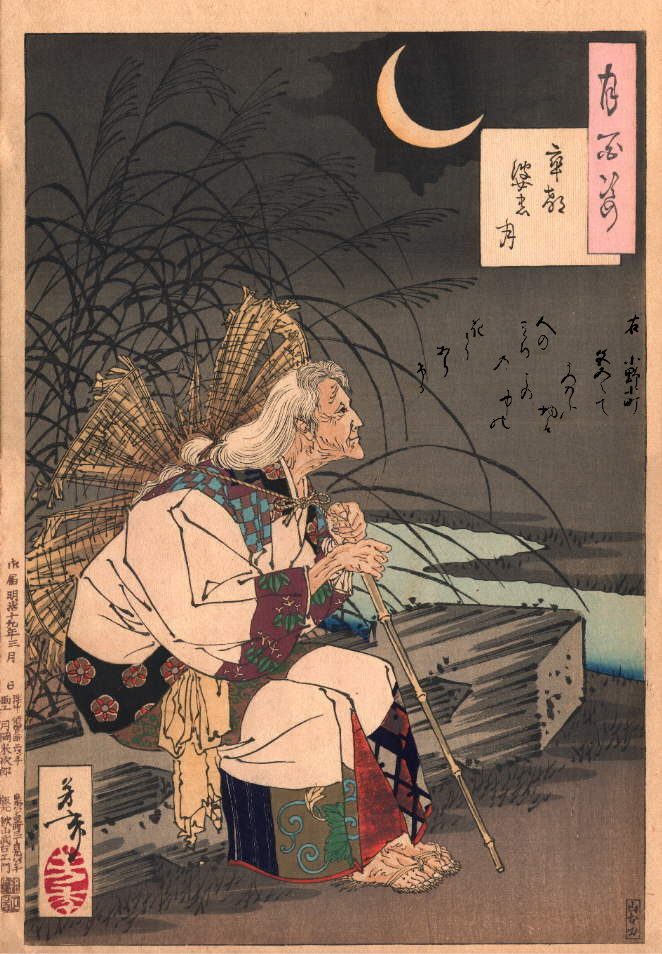
Ono no Komachi is a renowned figure in Japanese literature, particularly known for her exceptional beauty and poetic talent. As one of the Rokkasen, the six best waka poets of the early Heian period, she holds a significant place in Japanese literary history. Her name, Komachi, has become synonymous with feminine beauty in Japan, cementing her legacy as an icon.
Unfortunately, very little is known about Komachi’s life with certainty. The Kokin Wakashū, a poetry anthology, contains exchanges of romantic poetry between Komachi and various men. This provides some insight into her relationships but leaves many aspects of her life shrouded in mystery. It is believed that Komachi was born between 820 and 830, and she was most active as a poet during the middle of the ninth century.
Attempts have been made to uncover details about her birthplace and family background, but conclusive results have proven elusive. Arai Hakuseki, a scholar from the Edo period, proposed the theory that there were multiple women named Komachi, and the legends surrounding her referred to different individuals. This theory was later expanded to suggest the existence of four distinct “Komachis.” Some conjecture that she served as a lady-of-the-bedchamber in the court of Emperor Ninmyō and engaged in relationships with other men after his death in 850.
Various legends have arisen surrounding Komachi, dating as far back as the eleventh century. These legends were frequently incorporated into Noh plays. One popular legend suggests that Komachi was a lover of Ariwara no Narihira, another esteemed poet from the same era. It is speculated that this legend may have originated from the accidental placement of one of her poems next to one of Narihira’s. Another set of legends portrays her as cruel and heartless towards her lovers, particularly Fukakusa no Shōshō, a high-ranking courtier. One story recounts how she promised to become his lover if he visited her continuously for a hundred nights, but he tragically passed away on the ninety-ninth night. Yet another legend depicts an elderly Komachi, abandoned and ridiculed due to her faded beauty, wandering the streets in tattered clothing. These stories serve as punishments for her mistreatment of her previous lovers. Several legends also revolve around her death, often featuring her skull in a field and the haunting sound produced when the wind passes through its eye socket, symbolizing Komachi’s anguish.

Komachi’s poetry primarily exhibits a melancholic tone. Almost all of her extant poems convey a sense of anxiety, solitude, or passionate love. Critics have praised her as one of the greatest erotic poets across all languages. Her poems exhibit a complex verbal style that distinguishes the poetry of the Kokinshū Anthology. Within the Kokinshū, her poems are mainly categorized as “love” or “miscellaneous” poems, with only one classified differently. Komachi is the sole female poet mentioned in the kana preface of the anthology, which describes her style as a combination of old-fashioned naivety and delicacy.
One of her most famous poems, included as number nine in Fujiwara no Teika’s Ogura Hyakunin Isshu, speaks of a life filled with emptiness, where her looks and talents have faded like cherry blossoms in the endless rain. The poem is rich in symbolism and carries multiple layers of meaning. It has garnered attention and analysis by scholars and translators.
Komachi’s intense and sincere emotional expressions in her poetry set her apart and continue to captivate readers. She, along with other poets of the ninth-century “dark age” of waka, played a significant role in enhancing the expressive powers of Japanese poetic art. Despite the passage of time,
Here’s a sneak peek into my ongoing translations of Japanese women between 1100 and : These poems are excerpts from the “Kokinshu” anthology, specifically from the preface (序)
- 思ひつつ寝ればや人の見えつらむ夢と知りせば覚めざらましを “When I fall asleep, would the person I long for appear in my dreams? If I know it is just a dream, I wish not to wake.” – Kokinshu, Preface
- 色見えで移ろふものは世の中の人の心の花にぞありける “All things in this ever-changing world are like flowers of the human heart.” – Kokinshu, Preface; Selected Collection of Excellent Poems from Past and Present, Selected by Noriko Ban (President of Ikebukuro Matsuya)
- わびぬれば身を浮草の根を絶えて誘ふ水あらば往なむとぞ思ふ “If I were to endure the pain of love, like the water flowing ceaselessly, I would willingly go, even if it means severing my ties with the floating grasses.” – Kokinshu, Preface
- わが背子が来べき宵なりささがにの蜘蛛のふるまひかねてしるしも “This evening, my beloved will come. The sign is the web of a spider glistening in the morning dew.” – Kokinshu, Preface
- いとせめて恋しき時はむばたまの夜の衣をかへしてぞきる “In the intense longing of love, I change my night garments again and again, unable to sleep.” – Kokinshu, Preface
- うつつにはさもこそあらめ夢にさへ人めをもると見るがわびしさ “In reality, it should not be so, yet even in dreams, I am aware of your presence. How lonely it is.” – Kokinshu, Preface
- かぎりなき思ひのままに夜もこむ夢ぢをさへに人はとがめじ “As the endless thoughts fill the night, even in dreams, no one can blame me.” – Kokinshu, Preface
- 夢ぢには足もやすめずかよへどもうつつにひとめ見しごとはあらず “In dreams, my feet find no rest as I wander, but what I saw with my own eyes in reality was nothing.” – Kokinshu, Preface
- うたた寝に恋しき人を見てしより夢てふものはたのみそめてき “In my dozing state, I saw the person I long for, and now I desire to fall into dreams.” – Kokinshu, Preface
- 秋の夜も名のみなりけりあふといへば事ぞともなく明けぬるものを “Even the autumn nights have lost their significance. If only we could meet, the dawn would not break so easily.” – Kokinshu, Preface
- 人にあはむ月のなきには思ひおきて胸はしり火に心やけをり “When I think of the moon, which I cannot share with anyone, my heart aches like a burning flame.” – Kokinshu, Preface
- 今はとてわが身時雨にふりぬれば事のはさへにうつろひにけり “Now, as I am drenched in the passing showers, everything around me has become transient.” – Kokinshu, Preface
- 秋風にあふたのみこそ悲しけれわが身むなしくなりぬと思へば “Only meeting in the autumn wind is so sorrowful. When I think of myself becoming empty.” – Kokinshu, Preface
Now it’s your turn. Tell me about some of your favorite poems or writings from other languages? Any Mexican fables? Indian parables? African sagas? Stories from around the globe which stir your heart with longing and an eagerness for life?
Leave your thoughts in the comments below and please consider subscribing. I’d love to get to know you better.
Cheers,
Nicholas


Leave a Reply