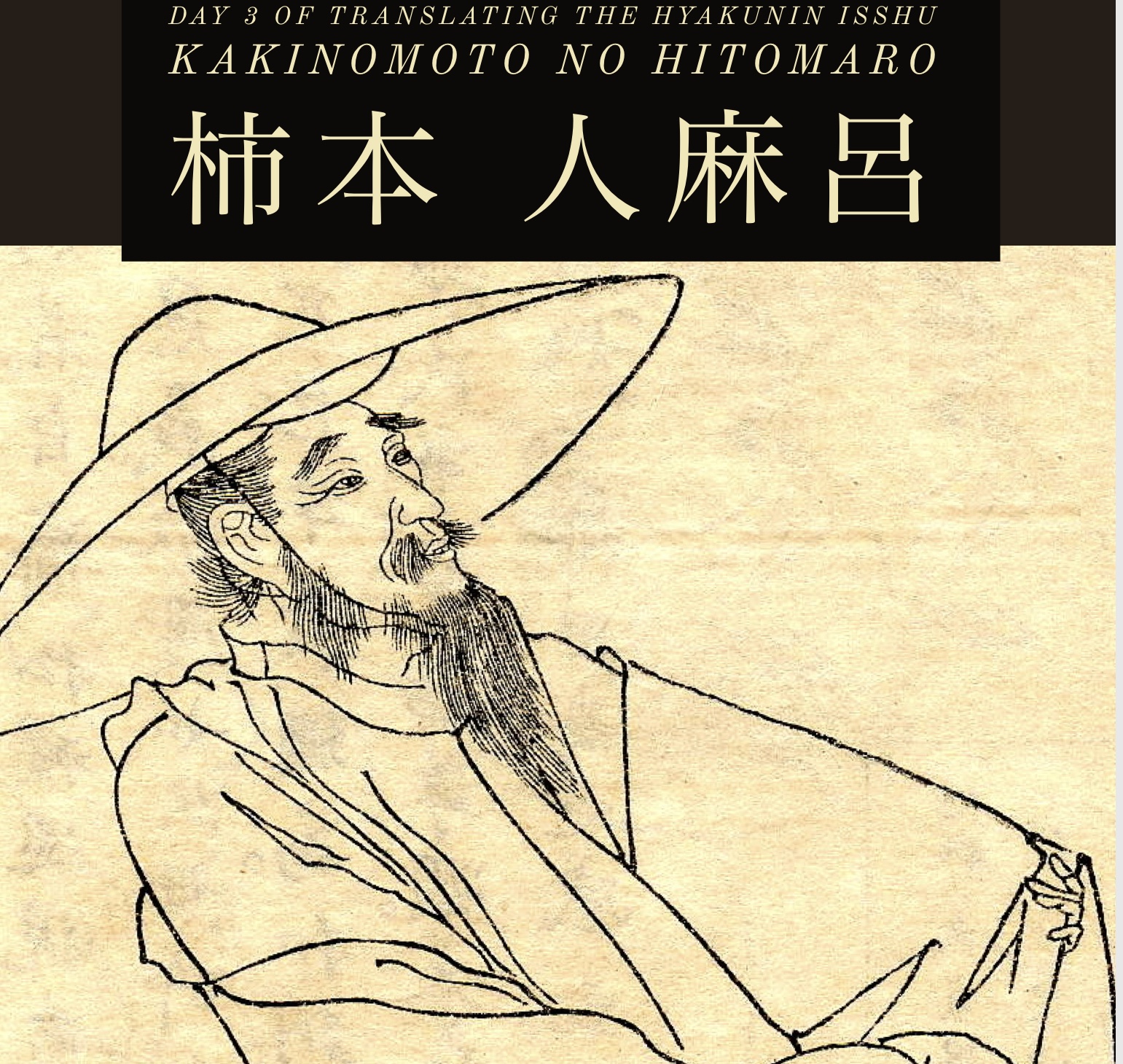
Welcome back to our exhilarating journey through the enchanting world of the Hyakunin Isshu! Today, we delve into Day 3 of our ambitious 100-day challenge, where we explore the poetic genius of Kakinomoto no Hitomaro, a celebrated waka poet from ancient Japan. As we unravel the layers of his captivating verse, we will once again witness the magic of translation and the power it holds in bringing ancient beauty to the modern world.
In this installment, we turn our attention to a visually evocative poem that mesmerizes with its imagery and captures the essence of solitude and yearning. Attributed to Kakinomoto no Hitomaro, this composition transports us to a realm where the mountain pheasant’s tail feathers gracefully extend, mirroring the poet’s own night of solitary contemplation.
Throughout this article, we aim to showcase not only the translation itself but also the intricacies of the process. By delving into each line of the poem, we will explore the challenges faced in capturing the sense, meaning, and emotional depth of the original classical Japanese in our modern rendition. Our distinctive style, playful yet scholarly, aims to captivate both poetry enthusiasts and potential employers, highlighting our prowess in translation and localization theory.
So, join us as we embark on this delightful journey, balancing scholarly precision with an engaging and light-hearted approach. Let the words of Kakinomoto no Hitomaro guide us through the labyrinth of emotions and cultural nuances, allowing us to unravel the timeless beauty hidden within his verses. Prepare to be enchanted as we continue to unlock the treasures of the Hyakunin Isshu, one poem at a time.
Translation
あしびきの
山鳥の尾の
しだり尾の
ながながし夜を
ひとりかもねむ .
As the mountain pheasant’s
Tail feathers extend
In a long, long line,
I too spend the night alone,
Sleepless and desolate.
Line-by-line breakdown:
あしびきの (ashibiki no) – “as the mountain pheasant’s”
山鳥の尾の (yamadori no o no) – “tail feathers extend”
しだり尾の (shidari o no) – “in a long, long line”
ながながし夜を (naganagashi yo o) – “I too spend the night alone”
ひとりかもねむ (hitori kamo nemu) – “sleepless and desolate”
In this evocative poem attributed to Kakinomoto no Hitomaro, the poet draws a vivid comparison between his own state of solitude and the extended tail feathers of a mountain pheasant. The mountain pheasant, known for its impressive plumage, symbolizes beauty and grace in Japanese culture. By likening his lonely night to the bird’s elongated feathers, the poet expresses a sense of elongated solitude and yearning.
The first two lines set the scene, describing the mountain pheasant’s tail feathers extending gracefully. The choice of “ashibiki” (mountain pheasant) emphasizes the wild and natural element of the image. The poet then shifts the focus to his own experience, expressing that he too spends the night in solitude.
The phrase “naganagashi yo” (long, long night) captures the elongated sense of time, emphasizing the poet’s feelings of loneliness and longing. The repetition of the word “naganagashi” adds a rhythmic quality to the line, enhancing the poetic flow.
Finally, the poet concludes with the poignant expression “hitori kamo nemu” (sleepless and desolate). This phrase encapsulates the emotional state of the poet, emphasizing his sleeplessness and the profound sense of desolation he feels in his solitary state.
Through this concise and visually descriptive poem, Kakinomoto no Hitomaro skillfully conveys a universal feeling of loneliness and longing. The use of natural imagery and the poet’s personal experience create a profound and relatable emotional impact.
Kakinomoto no Hitomaro, also known as Kakinomoto no Hitomaro or Kakinomoto no Hitomaro (柿本 人麻呂 or 柿本 人麿), was a highly esteemed waka poet and noble of the late Asuka period in Japan. Born around the 650s, he belonged to the influential Kakinomoto clan in Yamato Province. While many details about his life remain uncertain, his exceptional talent is evident from his contributions to the Man’yōshū, the oldest anthology of waka poetry.
Hitomaro served as a court poet in the esteemed position of Empress Jitō’s court, where he composed numerous works praising the imperial family. His most notable achievements include his elegies dedicated to various imperial princes. Additionally, he was renowned for his skill in composing travel poems that vividly depicted the beauty of the natural world.
Acknowledged as one of the Thirty-six Poetry Immortals, Hitomaro received high praise from Ōtomo no Yakamochi, the presumed compiler of the Man’yōshū, and Ki no Tsurayuki, the principal compiler of the Kokin Wakashū. They respectively referred to him as “Sanshi no Mon” (山柿の門) and “Uta no Hijiri” (歌の聖) roughly “the Saint of Poetry”. In the Heian period and beyond, he came to be affectionately called Hito-maru (人丸). Over time, he has been revered as a divine figure associated with poetry and scholarship. His profound contributions have solidified his place among the four greatest poets in Japanese history, alongside Fujiwara no Teika, Sōgi, and Bashō.

Looking forward, looking back
3 down. 97 to go. So how do we feel so far? Questions? Comments? Concerns? I’d love your feedback. In fact, I live and breathe your feedback!
As we conclude our exploration of Day 3’s captivating poem by Kakinomoto no Hitomaro, I hope that you have enjoyed our journey through this far, digesting the Hyakunin Isshu.
If you haven’t already, please subscribe my mailing list to stay updated on these daily translations and cultural explorations. By subscribing, you’ll gain exclusive access to each day’s article directly in your inbox, ensuring you never miss a moment of this extraordinary adventure!
In several translations from now, thinking day ten or so, I’m limiting content to Patreon subscribers only. So if this interests you, please consider making a contribution and support this broke graduate student! All funds directly support my research into Classical Japanese and educational services for cultural consultancy.
And if you’re just joining or missed out on the previous days, fear not! You can catch up on Day 1 and Day 2 on the blog feed! Immerse yourself in the elegance of Emperor Tenji’s’s verses and the visually-descriptive world of Empress Jitō. Each day brings a new opportunity to appreciate the richness of ancient Japanese literature.
This series is a way for me to strengthen my ability to conceptualize Japanese aesthetics, network with other scholars of classical and premodern Japan, and continue working Japanese culture into my game writing, narrative design, and professional development.
I would like to express our deepest gratitude for your support and enthusiasm on this journey. Your readership inspires me to continue this quest of translating and unlocking the treasures of the Hyakunin Isshu. I hope that through this playful yet scholarly I provide a unique perspective that resonates with both poetry lovers and those seeking to explore the realm of translation and cultural adaptation.
Until our next rendezvous with a mesmerizing poem —tomorrow, Day 4,—, I bid you good day with the words of Kakinomoto no Hitomaro lingering in the air, inviting you to ponder the beauty and mystery of ancient verses. Subscribe now, and let us embark together on this extraordinary 100-day challenge of translating the Hyakunin Isshu.
Wishing you poetic inspiration and cultural enlightenment,
Nicholas,
The Wandering Scholar

Leave a Reply