
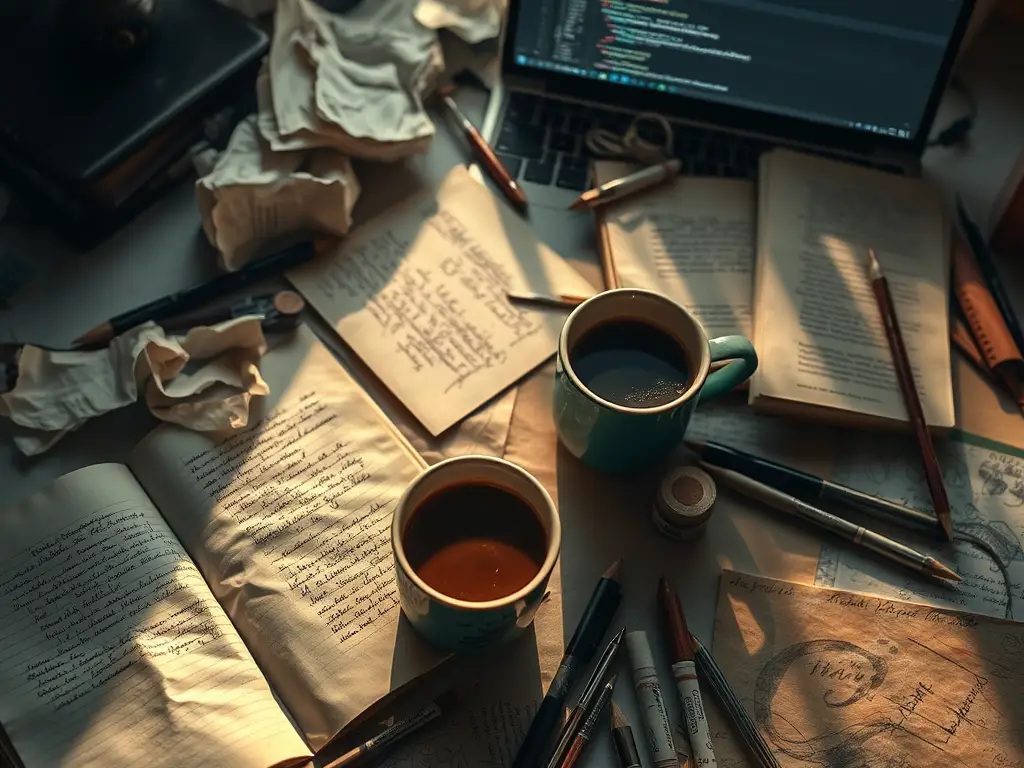
I wrote “Invocation: Muse Yourself” in the middle of an impossible week — deadlines stacked like unswept leaves, my brain a tidepool of good intentions and half-finished outlines. Somewhere between the fifteenth open tab and my third cold cup of coffee, I realized the poem wasn’t about calling upon the Muse.

It was about bargaining with my own distraction.
I’ve lived most of my creative life like this: in the space between awe and apology.
I adore the ritual of making — the sketchbook offerings, the late-night keystrokes, the incense of printer paper. But with ADHD, ritual often becomes rubble. Systems collapse. Calendars fossilize. And when the deadlines come due, I’m left scrambling through the ruins of half-brilliant ideas, promising myself that next time, I’ll finally learn to focus.
Yet somehow, the work still gets done — not cleanly, not neatly, but sincerely.
I think that’s what Muse Yourself became: a prayer for people like me, who mean well and make messes anyway. The Muse, in all her cosmic impatience, telling us to stop waiting for permission and start laughing at the chaos.
The Podcasts That Kept Me Sane
On the worst days — when the cursor blinks like an accusation and my brain refuses to line up its thoughts — I turn to voices that understand what it means to wrestle with creation.
Three Point Perspective — the podcast by Will Terry, Jake Parker, and Lee White — has been my long-distance mentorship. They talk about art as both craft and psychology, about the strange alchemy of turning self-doubt into portfolio pages. When I listen, I remember that illustration isn’t a linear path but a spiral, looping endlessly between “I can’t” and “I did.”
The Illustration Department Podcast has been my tether to sincerity. Every conversation feels like a reminder that art is allowed to be intimate, imperfect, and human — a living extension of our nervous systems, our grief, our humor.
And The Screenwriting Life — oh, that’s church. Meg LeFauve and Lorien McKenna make the writing process sound like a group therapy session at the end of the universe. They talk openly about doubt, rejection, and the tender absurdity of making art at all. Their honesty feels like the permission I never knew I needed.
Together, these voices form my invisible writer’s room. They keep me company when the world feels too loud, when my attention fractures like light through glass. They remind me that creative minds have always been messy — that even gods and muses work off deadline.
Rituals, Ruins, and Tiny Victories
My rituals are inconsistent, but they are sacred in their inconsistency.
Sometimes it’s incense and a timer. Sometimes it’s standing barefoot in the yard until I remember I have a body. Sometimes it’s just choosing one project and whispering, today, you win.
I’ve lost work to my scatteredness — essays unfinished, pitches unsent, drawings forgotten under piles of research. But I’ve also learned to forgive that part of myself. Because what looks like chaos is often compost. And eventually, something grows.
The truth is: the Muse never really left. She just changed shape — she became podcasts, reminders, friends, deadlines, and the stubborn desire to keep creating even when it feels impossible.
And maybe that’s what she meant when she said, Muse yourself.

Leave a Reply